The ten principles

A standard is not what you announce. It is what your choices make visible.

Not commandments. Points of return.

Life gets loud, standards get tested, and people drift. These principles give you plain language to come back to when the next right choice should be clear.

They are not ten things to perform perfectly. They are ten ways to tell the truth, choose deliberately and build evidence over time.

  1. Keep your word.

    Make fewer promises. Keep the ones you make.

    What it means

    Say yes with care. Once you commit, follow through, or speak honestly and early when the plan has to change.

    Why it is here

    Self-trust is built the same way trust with others is built: one kept promise at a time.
  2. Protect your focus.

    Give your attention a job.

    What it means

    Decide what deserves your attention before everything else competes for it. Focus is not isolation. It is attention with a direction.

    Why it is here

    What repeatedly gets your attention eventually shapes your work, your relationships and your life.

  3. Finish what you start.

    Close loops. Create evidence.

    What it means

    Carry meaningful work across the finish line. If something no longer deserves finishing, end it deliberately instead of letting it linger.

    Why it is here

    Unfinished work keeps asking for attention, while finished work shows you that your effort can be depended on.

  4. Choose growth.

    Take the honest next step beyond comfort.

    What it means

    Choose the next challenge that asks more of you, without pretending exhaustion is progress. Rest and recovery are part of growth.

    Why it is here

    Comfort can quietly become a ceiling when you stop choosing the next honest step.

  5. Learn every day.

    Turn experience into usable knowledge.

    What it means

    Pay attention to what your days are teaching you, then apply it. Information becomes useful when it changes a decision.

    Why it is here

    Growth slows when experience passes through you without reflection or action.

  6. Let habits speak.

    Let repetition show your values.

    What it means

    What you repeat speaks before your intentions do. Your habits show what receives your time, your care and your follow-through.

    Why it is here

    Who you are becomes believable through patterns, not announcements.

  7. Care for your body. Sharpen your mind.

    Look after the person who carries your plans.

    What it means

    Look after your physical health and your mental clarity with consistency, not obsession. Sleep, meals, movement, recovery and time to think belong in the plan.

    Why it is here

    Purpose is harder to sustain when the person carrying it is constantly depleted.

  8. Stop comparing.

    Measure against your own standard and evidence.

    What it means

    Learn from other people without borrowing their timeline or their definition of success. The useful comparison is between the standard you state and the choices you make.

    Why it is here

    Comparison creates noise. Evidence restores direction.

  9. Choose your circle with care.

    Spend time with people who tell you the truth.

    What it means

    Build relationships with honesty, support, boundaries and mutual growth. Look for people who respect the work, and be that kind of person for them.

    Why it is here

    The people around you help define what feels normal, possible and acceptable.

  10. Become someone you respect.

    Make choices your future self can stand behind.

    What it means

    Build a private standard you can live with when nobody is watching. Respect grows when what you say matters and what your choices show begin to match.

    Why it is here

    This is the question beneath every other principle: are your choices building a person you can honestly respect?

One principle. One week. One visible proof.

  1. Choose the principle your current evidence is asking for.
  2. Name one proof action that would make it visible this week.
  3. Review what happened without turning a miss into identity.
  4. Recover, refine and repeat before you move to another principle.

The free Scorecard takes one reading per principle from the last 14 days, so you can see which one to start with.

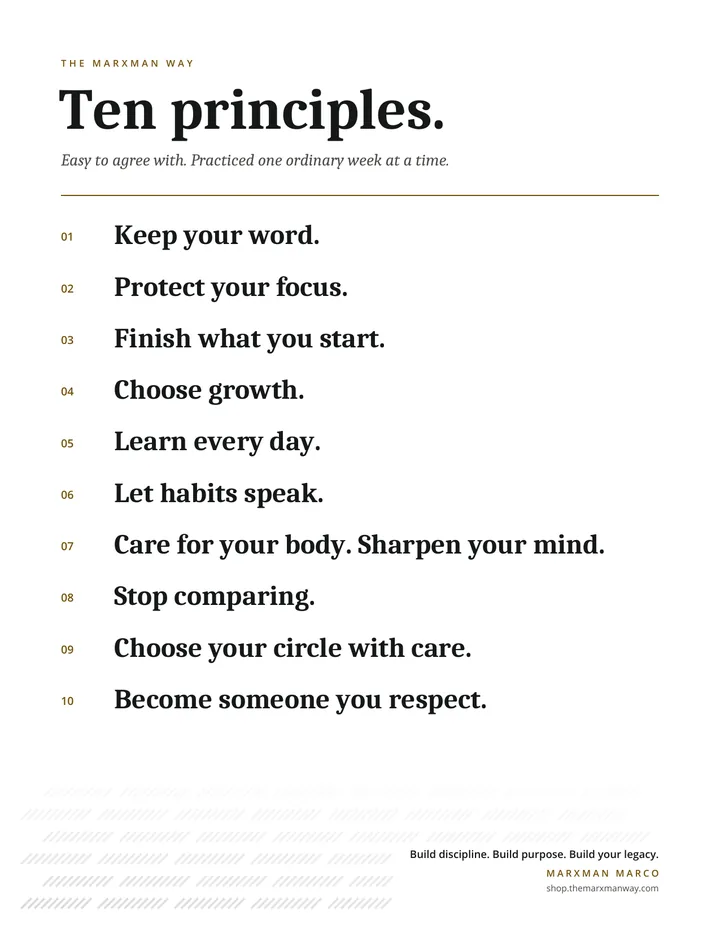
The 10 Timeless Principles Letter print: the heading Ten principles, then the ten principles numbered 01 to 10.

Keep the ten in sight.

The ten principles of The Marxman Way on one page, for a wall, a desk or a phone. The poster, the Letter print and both wallpapers are free.

FORGE

Coming soon: FORGE, a book series on the ten principles. Volume I, Foundation, comes first.

Start with one principle today